
Smart Film Electrical Wiring & Power Supply Guide
This document provides the complete official step-by-step procedures for electrode preparation, tool selection, and transformer connection to ensure the safe and stable operation of CX SMART FILM systems.
Generic Wiring Diagram
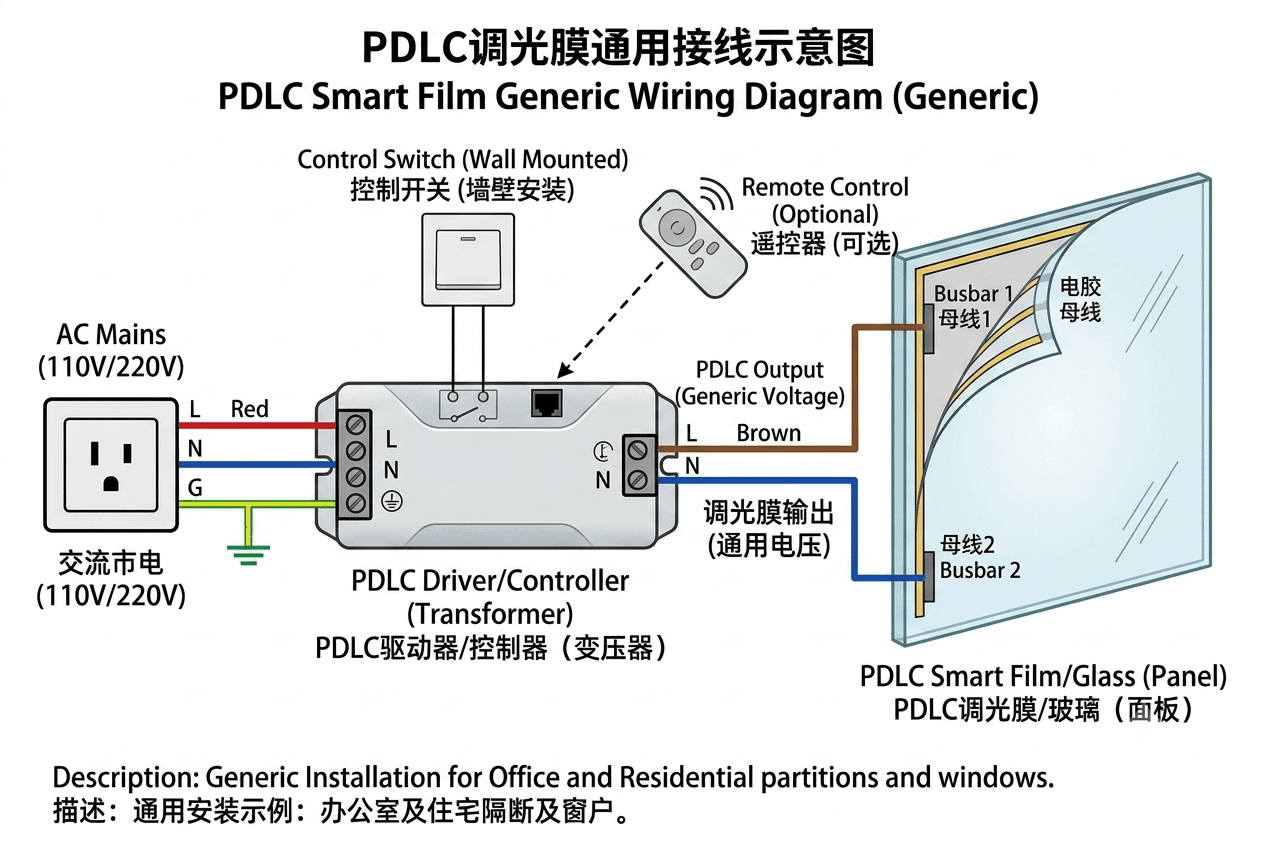
Standard configuration for architectural partitions and windows using the dedicated CX transformer.
Required Wiring Tools
Before starting the wiring process, please prepare the following dedicated tools and ensure they are clean and completely dry:
- Specialized Electrode Blade: For precise cutting to expose wiring ports.
- Scouring Pad, Water/Alcohol & Warm Air Blower: For removing the liquid crystal layer and thoroughly drying the exposed conductive area.
- Masking / Clear Tape: For isolating the port area and defining clear application boundaries.
- Lint-Free Micro-tip Cotton Swabs: Exclusively for the precise and even application of conductive silver paste.
- RSAI-175 Dedicated Conductive Silver Paste: High-purity factory-matched silver paste, the core material for optimal conductivity.
- Copper Foil Electrodes (9mm & 4mm): Sized to perfectly fit the adhesive and non-adhesive surfaces of the smart film.
- Soldering Iron & Solder Wire: For securely soldering power cables to the copper foil electrodes.
- Digital Multimeter: Essential for continuity testing, voltage measurement, and pre-installation safety checks.
Smart Film Wiring Process
- Step 1: Expose Wiring PortsThe conductive busbars of the smart film do not have positive or negative poles. Use a specialized electrode blade to cut a wiring port on each side where wiring is required. Tip: Partially peel back the protective film and fix it in place to easily expose the port area for precision cutting.
- Step 2: Clean the PDLC LayerUse a scouring pad dipped in water or alcohol to gently wipe the specified port area. Completely remove the liquid crystal coating until the transparent ITO conductive layer is fully exposed. Then, must use a warm air blower to thoroughly dry the exposed area.
- Step 3: Tape Masking / IsolationApply masking or clear adhesive tape horizontally along the edge of the cut port to define a neat boundary. This prevents the conductive silver paste from spilling over and contaminating the surrounding smart film surface.
- Step 4: Apply Conductive Silver PasteUsing a micro-tip cotton swab, evenly apply the RSAI-175 conductive silver paste to the exposed, transparent ITO layer. Dry fully with a warm air blower (Optimal curing: bake at 80°C for 30 minutes). Once the silver paste is completely cured, carefully peel off the masking tape.
- Step 5: Attach Copper Foil ElectrodesCut a suitable length of copper foil and press it tightly onto the cured silver paste layer. Attention: For self-adhesive film, select the 9mm copper foil for the adhesive side, and the 4mm foil for the exposed (non-adhesive) side. This sizing prevents raised solder joints from causing uneven glass adhesion or gaps.
- Step 6: Wire SolderingUse a soldering iron to melt the solder wire evenly onto the copper foil, then securely solder the power cable. We recommend soldering two wiring ports onto the same busbar as a dual safeguard against accidental disconnection during structural adjustments.
- Step 7: Pre-Installation & Power TestUse a digital multimeter to check circuit continuity. Perform a full power-on test to verify that the film switches smoothly between the "Transparent" and "Opaque" states before proceeding to final fixed installation.
Conductive Silver Paste Specifications
CRITICAL SAFETY WARNING
Strictly prohibit the use of inferior or non-factory alternative silver paste. Low-quality paste (often high in carbon and dark grey in appearance) severely degrades conductivity, leading to localized electrode heating, accelerated component aging, permanent film damage, and potential fire hazards.
Nano Silver Content
75% - 80%
Square Resistance
< 0.05 Ω/cm²
Viscosity
10,000-20,000 CPS
Curing Condition
80°C for 30 mins
- Exceptional Conductivity: Extremely low internal resistance ensures year-round stable operation, completely eliminating "hot spot" risks.
- Strong Adhesion & Flexibility: Withstands gentle rubbing and 180° outward folding during installation without detachment.
- High Chemical Stability: Highly resistant to environmental oxidation, as well as weak acids and alkalis.
- Easy Application: Produces thick, smooth, and continuous lines. Cures faster at lower temperatures compared to standard industrial silver pastes.
Need the offline wiring diagram?
Download the official CX SMART FILM wiring schematics for your electrical engineers.